
Road Expansion Project in UK Leads to Discovery of 8,000-Year-Old Human Remains
Note: AI technology was used to generate this article's audio.
- Thousands of years of history unearthed in Nottinghamshire during major road project preparations
- Archaeological finds reveal traces of human life dating back to 6000 BC
Archaeologists have uncovered a series of artefacts spanning thousands of years of Nottinghamshire’s history in central England, during early-stage work ahead of the widening of the A46 major road.
The discoveries were made as part of preparatory excavations before expanding the main route, with evidence suggesting human activity in the area dating back as far as 6000 BC.
A team carried out digs across more than 9.63 hectares of land in five fields near Newark, where a wide range of materials was uncovered from different historical periods.
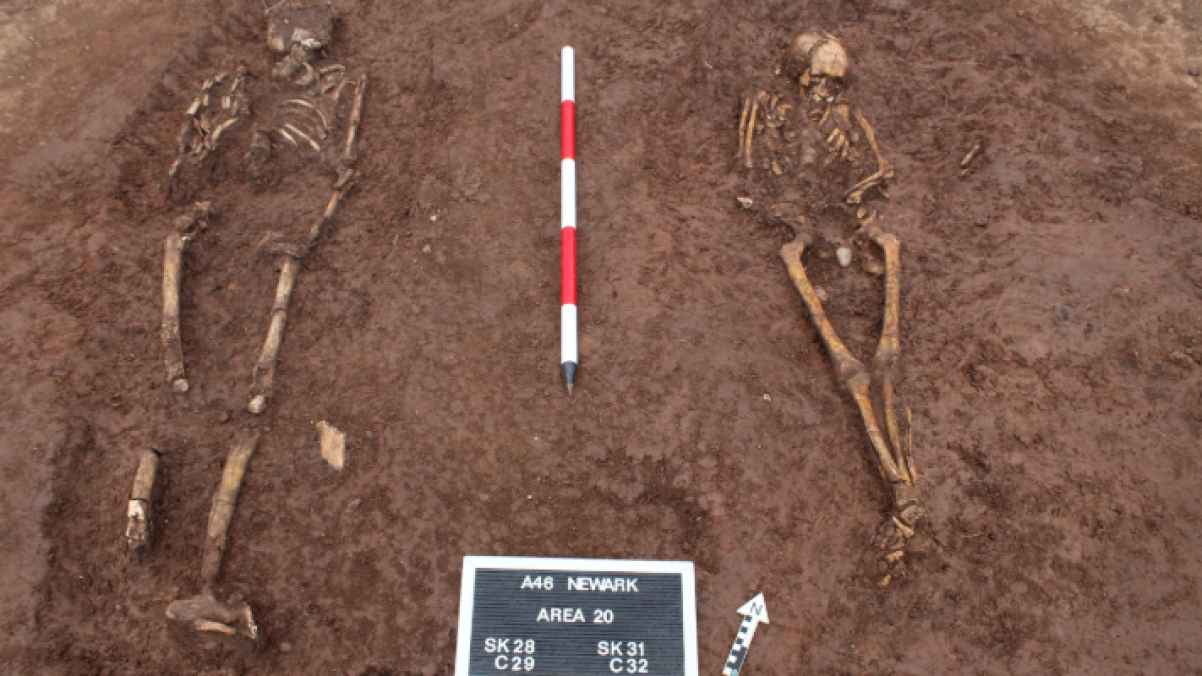
Among the finds were the remains of seven individuals, prehistoric flint tools, two likely Anglo-Saxon houses, and a Roman-era well.
Archaeologist Pese Salinas said: “It’s incredibly exciting to see these discoveries… I looked forward to being on site every day.”
The excavation forms part of preparations to widen approximately 6.4 kilometres of the single-carriageway A46 around Newark, between the Farndon and Winthorpe roundabouts.
The project will also include a flyover at a roundabout, construction of a new bridge over the A1, and the expansion of the Winthorpe roundabout.
Before engineering work begins, the area was surveyed for traces of ancient settlements.
Initial analysis suggests the uncovered burials date from the Iron Age to the Anglo-Saxon period, although further study is expected to refine the timeline more precisely.
Remains of a sunken-floor Anglo-Saxon structure, known as a “grubenhaus,” were also discovered—an uncommon find in Nottinghamshire.
Other artefacts include Roman and Iron Age pottery, flint arrowheads, and a stone quern used for grinding grain in the Neolithic period.
Salinas said the materials offer a unique insight into how ancient communities lived, what they ate, and how they built their homes and organized daily life.
He added that all artefacts and soil samples will now undergo detailed analysis by specialist researchers.
Naziya Sheikh, National Highways project manager for the A46 Newark scheme, said experts had done important work in revealing history that had remained buried for centuries without anyone knowing.
She added that there are hopes some of the finds could eventually be displayed publicly in Newark, with final decisions to be announced later.