
Chinese robot outpaces humans in marathon and sets new record – video
Note: AI technology was used to generate this article's audio.
- Robotic runner completes Beijing half-marathon in 50:26, beating top human time of ~57 minutes
- Autonomous machine takes title ahead of human record holder in major tech showcase event
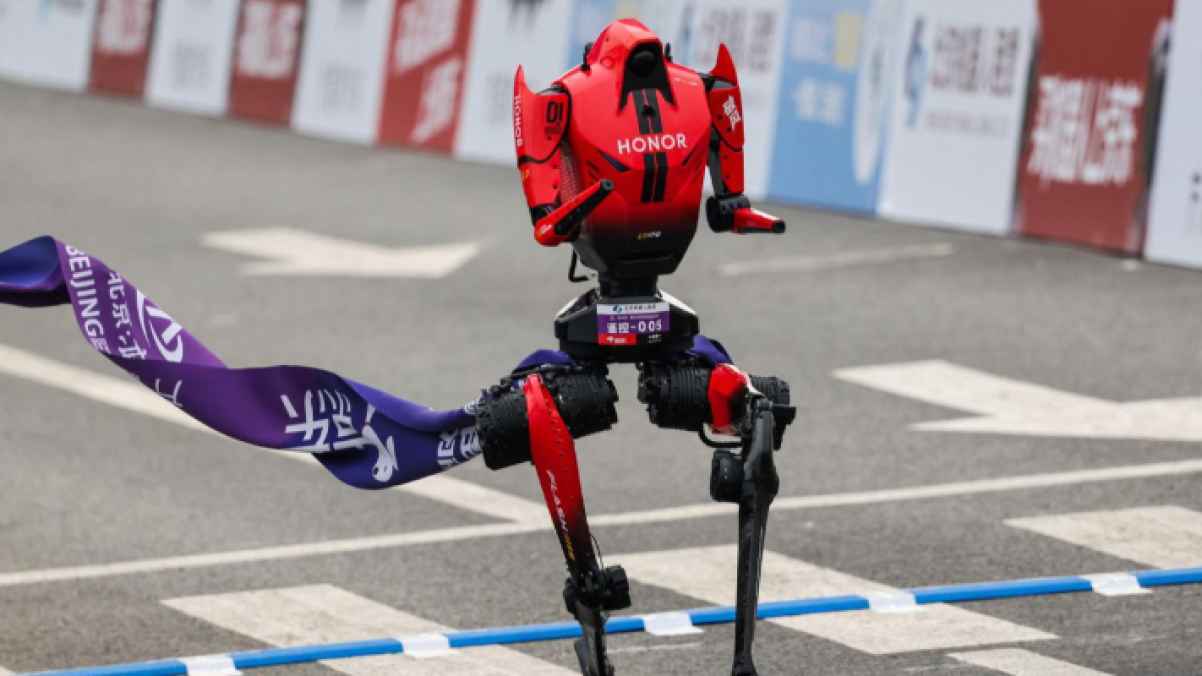
In a striking display of China’s rapid technological advancement, a humanoid robot secured victory in a half-marathon for robots held in Beijing on Sunday, finishing the course faster than the human world record for the same distance.
The winning robot, developed by Chinese smartphone maker Honor, completed the 21-kilometer race in 50 minutes and 26 seconds, according to Beijing E-Town, the event organizer.
The result surpassed the human benchmark set by Uganda’s Jacob Kiplimo, who completed the distance in about 57 minutes during a race in Lisbon in March.
The performance marks a major leap compared with last year’s edition of the event, when the winning robot required 2 hours, 40 minutes and 42 seconds to finish.
However, the race was not without incidents, as one robot fell at the starting line while another collided with a barrier along the course.
Engineer Du Xiaodi from Honor said the team was satisfied with the outcome, noting that the robot was designed with inspiration from elite human runners, featuring long legs of around 95 cm and an in-house developed liquid-cooling system.
He added that some of these technologies could later be adapted for industrial applications, including structural reliability and cooling systems.
Although widespread use of humanoid robots remains in early stages, the performance drew strong reactions from spectators.
One attendee said it was the first time robots had clearly outperformed humans in such an event, while another suggested it could signal the beginning of a new era.
According to organizers, around 40% of participating robots completed the course autonomously, while others were remotely controlled.
Reports also noted that another Honor robot finished in 48:19 under remote control, though the official winner was the autonomous unit under the competition’s scoring rules.