
Scientists Uncover Movements at the Edge of Earth’s Core
Note: AI technology was used to generate this article's audio.
- Study reveals motion of subducted tectonic plates deep within Earth
- Over 16 million seismic records uncover the mantle’s internal distortions
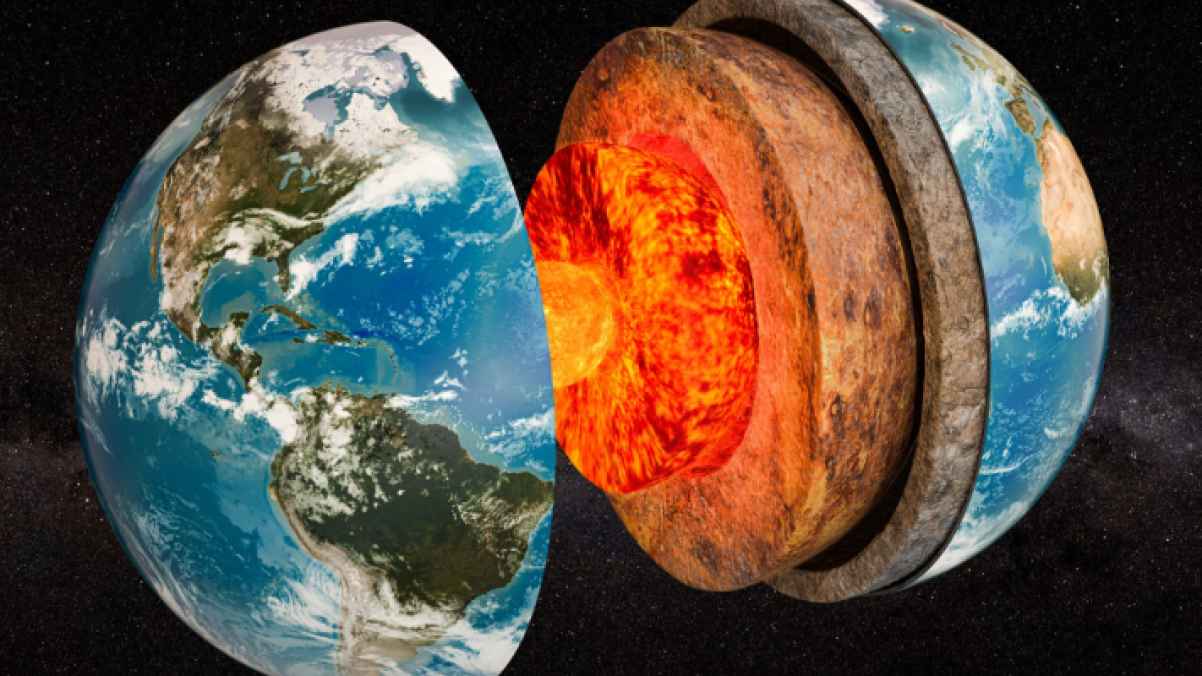
A team of scientists has produced an unprecedented picture of Earth’s internal movement at a depth of about 2,900 kilometers, at the boundary between the planet’s core and lower mantle, according to SciTechDaily.
The new study, published in The Seismic Record, reveals a hidden pattern of distortions in the deepest layer of the Earth’s mantle, where tectonic plates that have sunk thousands of kilometers beneath the surface accumulate.
This is the first study to examine this connection on a global scale, covering roughly 75% of the lower mantle above the core boundary.
Jonathan Wolfe of the University of California, Berkeley, said his team collected more than 16 million seismic recordings from 24 data centers worldwide to build a comprehensive map of this movement.
The study relies on measuring variations in the speed of shear waves generated by earthquakes as they pass through the mantle, revealing the structure and internal distortions of the material—a phenomenon known as “seismic anisotropy.”
Results show that about two-thirds of the analyzed regions contain strong signals of seismic differences, especially in areas believed to contain subducted plates.
Scientists believe these distortions arise from extreme pressure and temperature at the core-mantle boundary, which alters minerals and forms new patterns of “seismic fabric” within these plates.
Wolfe noted that areas showing weak or no signals do not necessarily lack distortion; the signals may simply be too faint for current detection methods.
He emphasized that the dataset is a “valuable treasure” that could pave the way for further discoveries about Earth’s deep internal structure.
“If we can achieve this,” Wolfe explained, “one day we will have enough information to understand the flow directions of material in the deepest mantle layer globally, track seismic anisotropy across different horizontal scales, and observe it from multiple angles.”