
Scientists Stunned by Discovery of Phenomenon Affecting Mars’ Water Supply
Note: AI technology was used to generate this article's audio.
- Small dust storms propel water high into Mars’ atmosphere
- Sudden hydrogen spike reveals significant water loss
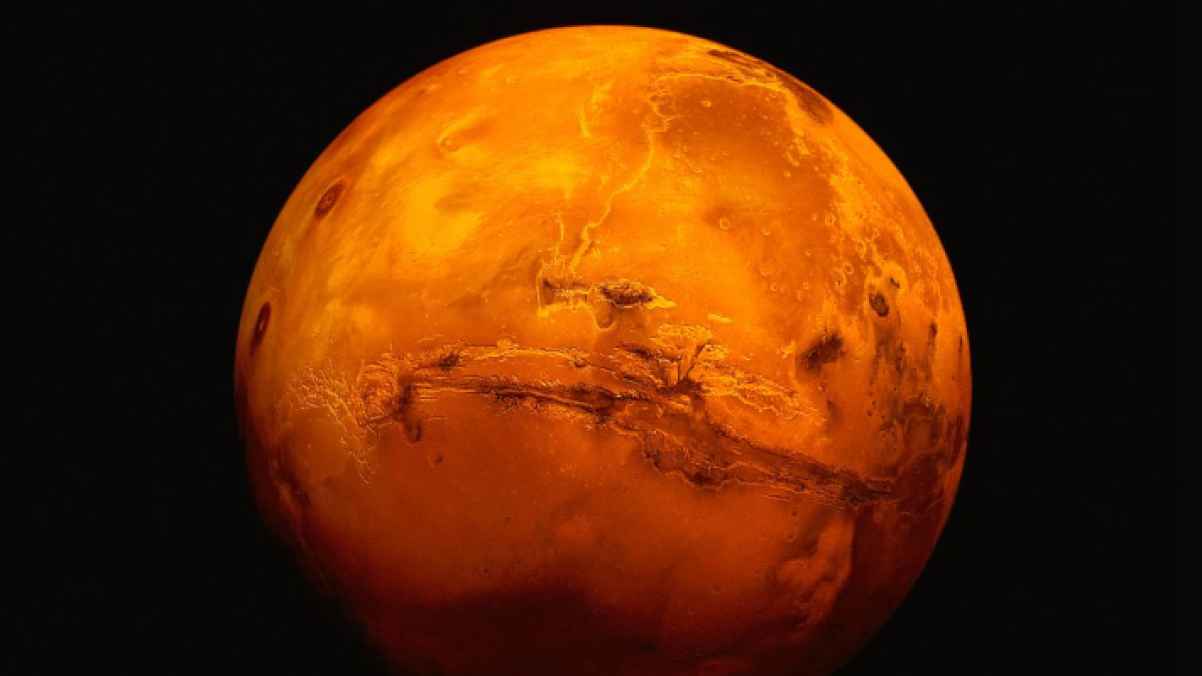
Space scientists have uncovered a surprising phenomenon on Mars, showing that small regional dust storms can lift water vapor to extreme altitudes in the planet’s atmosphere, making it easier for the water to escape into space.
Mars is now known as a cold, dry planet, but its surface features tell a very different story. Ancient channels, water-altered minerals, and other geological formations indicate that the planet once held abundant water and a far more dynamic environment.
Much of Mars’ lost water, however, remains unaccounted for, leaving researchers puzzled as they investigate how the planet transformed from a wetter world into the barren desert we see today.
A new international study published in Communications: Earth & Environment demonstrates that small-scale storms can play a significant role in water loss—a discovery that surprised scientists, especially since the storm occurred during the Northern Hemisphere summer, previously thought to contribute little to this process.
Adrián Brines, a researcher at the Instituto de Astrofísica de Andalucía (IAA-CSIC) and co-lead author, explained: “These findings reveal the impact of this type of storm on Mars’ climate evolution and open a new pathway for understanding how the planet lost much of its water over time.” Co-lead author Shohei Aoki of the University of Tokyo and Tohoku University contributed to the study.
Dust storms have long been linked to water loss on Mars, but most prior research focused on massive, planet-wide events. This study shows that smaller, regional storms can also lift water to higher altitudes, where escape into space is easier. The discovery challenges earlier assumptions that water loss primarily occurred during the Southern Hemisphere summer.
During Martian Year 37 (2022–2023 on Earth), scientists observed a dramatic spike in water vapor in the middle atmosphere associated with this unusual storm, with water levels reaching ten times the normal concentration—a rise never seen in previous years and not predicted by existing climate models.
Shortly after, researchers detected a major increase in hydrogen at the exobase—the boundary where Mars’ atmosphere transitions into space—rising 2.5 times higher than in previous years during the same season. Hydrogen forms when water molecules break apart, providing a direct measure of water loss from the planet.
“This adds an essential piece to the puzzle of Mars’ long-term water loss and shows that short but intense events can play a meaningful role in the Red Planet’s climate evolution,” Aoki concluded.
The study relied on data from multiple Mars missions, including ESA’s ExoMars Trace Gas Orbiter (TGO) with its NOMAD instrument, NASA’s Mars Reconnaissance Orbiter (MRO), and the Emirates Mars Mission (EMM), all currently orbiting Mars.