
From a journey of treatment to a displacement tent… she faces Gaza with a weary heart and a living hope
Note: AI technology was used to generate this article's audio.
Huda Abu Abed returned to Gaza after months weighed down by pain The moans of exile and its sorrow are reflected in the eyes of those returning to Gaza
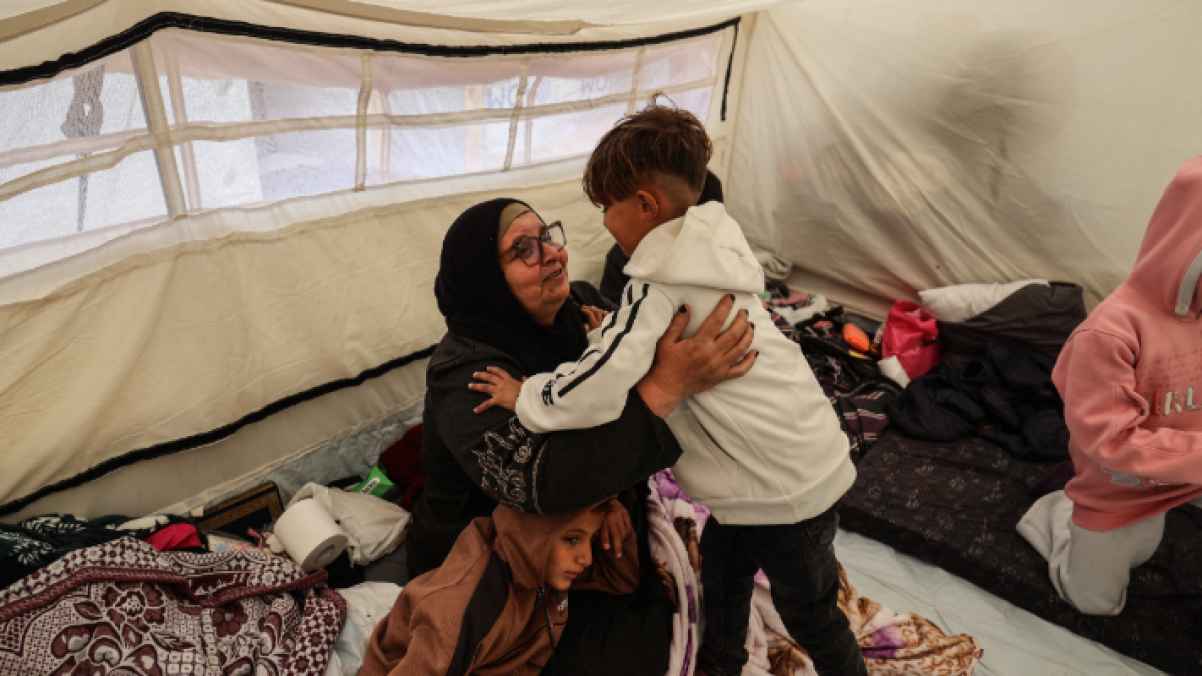
Inside a simple tent hastily set up in one of the neighborhoods of Khan Yunis, the Palestinian woman Huda Abu Abed sat among her family, surrounded by faces she had long missed, in a moment that captured both the agony of absence and the warmth of return. Her return from Egypt through the Rafah crossing was not just a passing journey, but the return of a heart exhausted by exile and illness to an embrace that had never abandoned her, despite all the bombing, displacement, and waiting it had endured.
Huda, who suffers from a heart condition, had left the Gaza Strip at the beginning of 2024 as part of the lists of patients allowed to travel to Egypt for treatment. There, she fought her silent battle with pain, far from her family, her home, and her city that had never left her memory. Between hospital walls, her greatest fear remained that she would not be able to return — not only because of illness, but also because of closure, siege, and the long road home.
Today, after heavy months of anxiety and anticipation, Huda has returned to Gaza. Yet she returned to a tent instead of a home, and to a city weighed down by rubble instead of the streets she once knew. Still, the moment she sat among her loved ones inside the family tent in Khan Yunis seemed greater than all losses — a small survival amid a sea of grief, and a message that staying with those we love is the greatest form of healing.
A battle with life
In her eyes, tears blended with gratitude, and pain with hope. She did not need words to explain what she felt; her features alone were enough to tell the story of a woman who survived illness, yet continues to fight the battle of life in a place where the most basic rights are still postponed, and the simplest dreams are painfully out of reach.
Huda Abu Abed’s story is not an individual case, but a condensed image of thousands of patients in Gaza who are waiting for their turn on travel lists, for a chance to cross, or for a decision that allows them to search for a life beyond the boundaries of pain. Between one tent and another, between a hospital and a crossing, the human dimension remains the most present in Gaza’s story — where returning to one’s family becomes an achievement, and returning home turns into a miracle.