
Paralyzed man regains ability to walk using artificial intelligence
Note: AI technology was used to generate this article's audio.
- Suffered complete paralysis during New Year's swim
- Regained partial movement and walking with modern technology
Dan Richards witnessed a life-changing transformation after a tragic accident during his swim on New Year’s Eve 2023.
Richards, 37, suffered a neck injury when a strong wave flipped him over on Langland Bay beach in Swansea, leaving him completely paralyzed.
Richards said: "I knew instantly that I was paralyzed; I couldn’t move a thing."
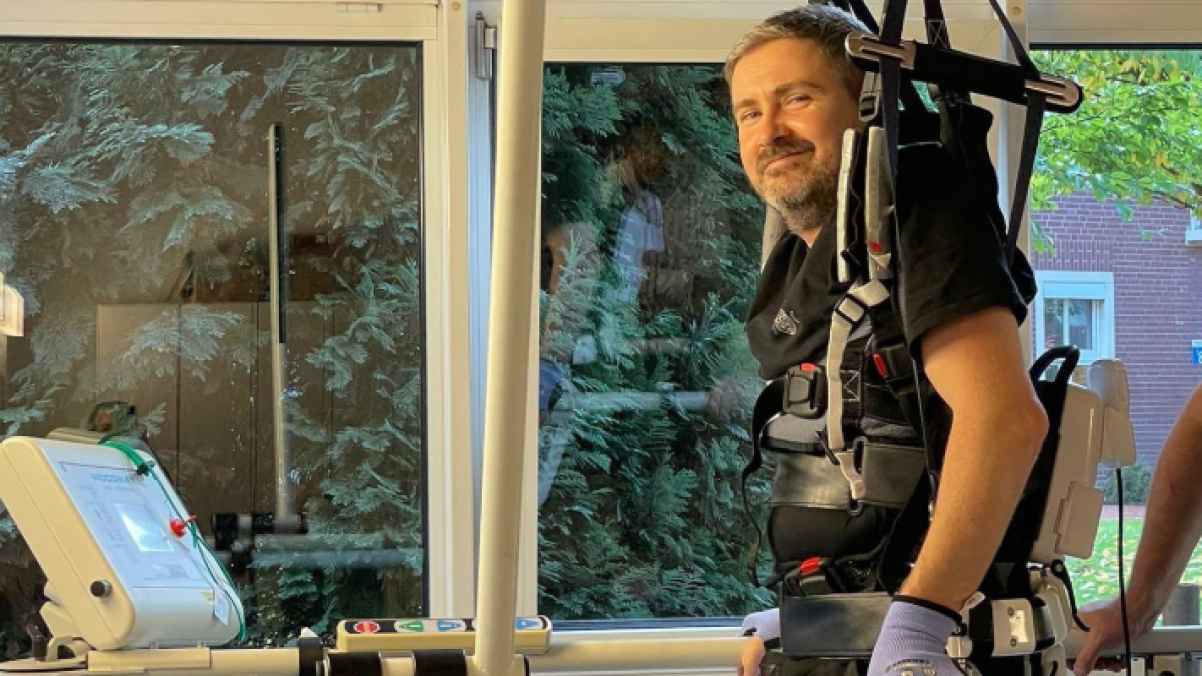
Doctors confirmed he would remain bedridden, but two years later he uses a wheelchair, can move his arms and fingers, and has even walked with the help of artificial intelligence technologies in Wales and Germany.
The accident occurred while Richards and his 40-year-old partner Anna were celebrating the New Year with a cold-water dip.
Richards recalled: "I got hit by a wave, flipped backwards, and my neck snapped… everything changed in an instant."
Anna described the terrifying moment as she saw Dan struggling and screaming for help: "We dragged him out, but he was just dead weight… and the waves were rushing in fast."
After being taken to a hospital in Bristol, the family received the shocking news that Richards was paralyzed from the neck down, and was likely to remain bedridden for life.
Anna said: "I had to tell his parents… there were no words to soften the shock."
Over time, Richards showed strong determination and began to feel slight movements in his fingers, giving him hope of recovery.
He added: "Every small step motivated me to keep going… gradually I regained feeling in my legs and limbs, could move my arms and fingers, and even hold objects."
Richards underwent specialized physiotherapy in a clinic in South Wales, using an innovative treatment combining a robotic device that mimics human walking and an electrically stimulated suit with sensors.
Jakko Brouwers, a neurophysiotherapist, explained that Richards was "extremely motivated" and that the system helped develop a walking pattern using artificial intelligence.
Despite the high costs, family and friends raised funds to allow him to try experimental therapy in Germany, where he received spinal stem-cell treatment alongside wearing a specialized movement-assist suit.
Richards explained: "The sensors convert brain signals into movement; the longer I continue, the stronger the signals, and eventually I can walk without the suit."
Richards is now preparing to complete the final six weeks of treatment and plans to obtain a European medical visa, affirming his determination to face every challenge and not give up.
He said: "Technology is advancing rapidly… every progress we make now shapes a better future."