
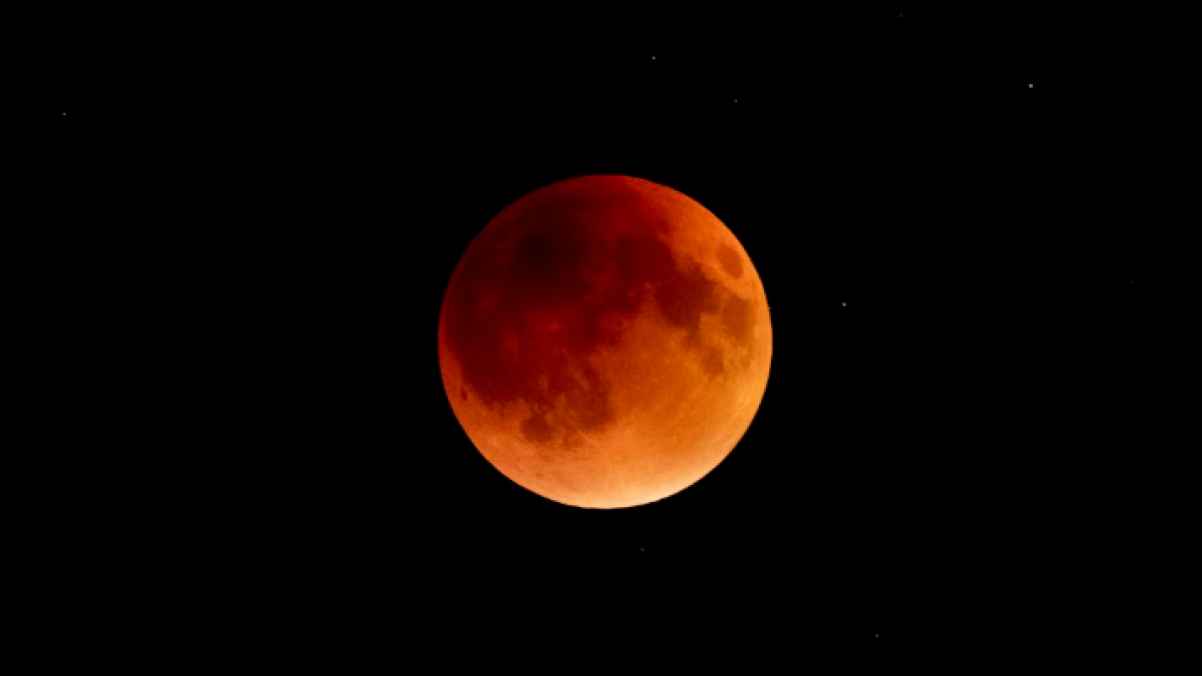
Will the “Blood Moon” Be Visible in Jordan’s Sky on Tuesday?
Note: AI technology was used to generate this article's audio.
- A rare total lunar eclipse, known as the “Blood Moon,” will occur on Tuesday
- It will be visible in North America, Australia, and New Zealand
Regions across North America, Australia, and New Zealand will witness this rare celestial event on Tuesday.
Astrophysicist Dr. Rebecca Allen from Swinburne University predicts the moon will turn a deep, coppery red as it passes fully into Earth’s shadow.
This will be the last eclipse of its kind visible for nearly three years.
A lunar eclipse happens when Earth aligns between the sun and the moon, blocking direct sunlight. Some sunlight still reaches the moon indirectly, giving it a sunset-like hue.
Dr. Allen explains: “Any light passing through Earth’s atmosphere transforms the lunar surface into a deep, coppery red.”
Dr. Brad Tucker from the Australian National University notes that the small amount of sunlight “skims” Earth’s atmosphere, much like a sunrise or sunset, illuminating the moon in an orange-red shade.
For optimal viewing, Allen recommends being away from city lights and allowing 10–15 minutes for eyes to adjust to the dark.
Jupiter will also appear high in the sky, forming what Allen calls “a perfect pairing.”
Total lunar eclipses generally occur every 18 months to three years. The next total eclipse will be on New Year’s Eve 2028, visible in Europe, Asia, Australia, and Africa, but not the Americas.
The next total lunar eclipse visible in North America will be in June 2029, while a partial eclipse will occur on 28 August 2026. The Americas and Africa will see it best, but it will be almost invisible from Australia and New Zealand.