
Black hole awakens after 100 million years and erupts like a cosmic volcano
Note: AI technology was used to generate this article's audio.
- Astronomical observations reveal a sudden resurgence of activity in a distant black hole within a faraway galaxy
- New data highlights a complex interaction between jets and surrounding gas inside a massive galaxy cluster
Scientists have captured a rare sight of a black hole “coming back to life” in a distant galaxy, in an event described as a “cosmic volcano” spreading its impact across vast regions of space, according to ScienceDaily.
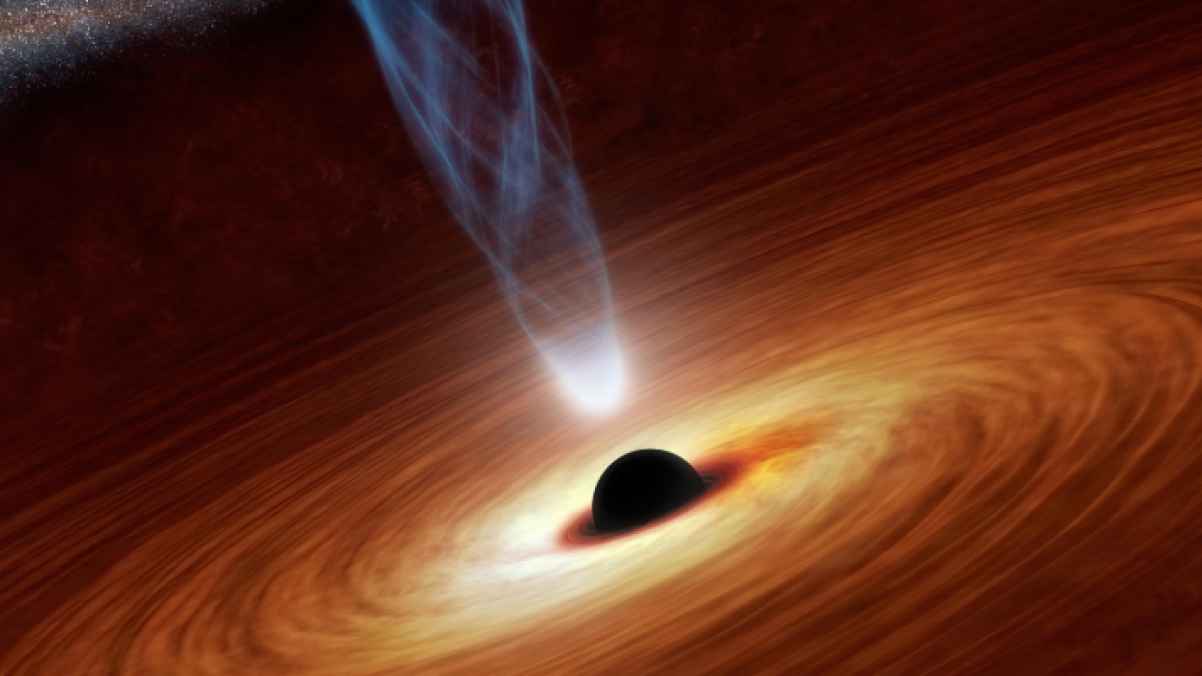
The discovery focuses on galaxy J1007+3540, where researchers observed that the black hole at its center has resumed launching powerful jets of matter and energy after lying dormant for nearly 100 million years.
A violent struggle with a harsh galactic environment
Radio observations show that the newly launched jets are facing strong resistance from hot gas surrounding the galaxy within a massive galaxy cluster, causing them to bend and become distorted as they spread.
According to a study published in a leading astronomy journal, researchers relied on advanced radio telescopes in the Netherlands and India to capture these details.
Repeated activity over millions of years
What makes this galaxy unusual is that it does not show a single burst of activity, but instead reveals repeated cycles of activity and dormancy. This suggests the black hole goes through long quiet phases followed by powerful outbursts.
Images also show bright, newly formed jets at the center, surrounded by older remnants of past activity that have gradually weakened and faded over time.
A “cosmic volcano” returns
The lead researcher said the observed phenomenon resembles a cosmic volcano erupting again after a long period of calm, but on an enormous scale spanning hundreds of thousands of light-years.
Researchers added that this layering of old and new activity shows the black hole does not operate continuously, but instead switches on and off across cosmic timescales.
The surrounding environment reshapes the galaxy
One of the key findings is that the dense hot gas in the galaxy cluster does not just surround the system—it directly shapes the jets, bending, compressing, and redirecting them.
Faint trails of material were also detected stretching over long distances, suggesting that the effects of these eruptions can persist for millions of years.
Why this discovery matters
This type of observation helps scientists better understand how black holes behave over long periods, how they influence the evolution of surrounding galaxies, and whether they undergo repeated cycles of activity rather than constant output.
Researchers hope to conduct more detailed studies in the future to observe the galaxy’s core more clearly and track how the newly formed jets interact with their environment.