
Scientists discover an unprecedented planetary system
Note: AI technology was used to generate this article's audio.
- Observation of an unusual star system with non-uniform planets and atypical gravitational interactions
- Rapid orbital changes that could reshape the planetary architecture within centuries
Data from NASA’s TESS telescope, in collaboration with the ASTEP observatory at the South Pole, has revealed a rare exoplanetary system outside the Solar System that scientists describe as fundamentally different from anything previously known. The planets orbit the star TOI-201, located about 370 light-years from Earth, according to Space.
Scientific reports indicate that the system exhibits an unusual phenomenon, where planetary orbits change in ways that can be observed over relatively short time periods—something not previously recorded with such clarity in other planetary systems.
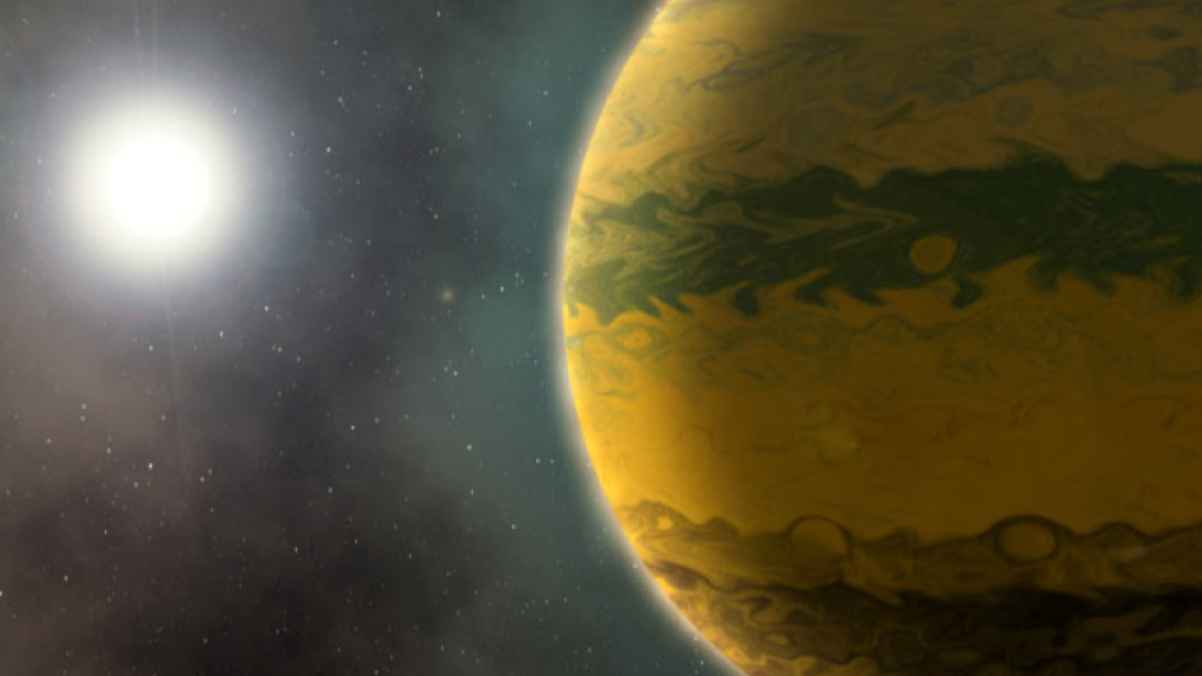
The host star TOI-201 has a mass about 1.3 times that of the Sun and is roughly 30% larger in diameter. It is orbited by three highly diverse planetary bodies, including a “super-Earth” rocky planet with a mass six times that of Earth, completing an orbit in just 5.8 days, alongside a gas giant about half the mass of Jupiter orbiting every 53 days, and another massive planet 16 times Jupiter’s mass with an orbital period of about 7.9 years.
Scientists say this sharp diversity sets the system apart from most planetary systems, which are often compared to “peas in a pod,” where planets tend to share similar sizes and orbital characteristics. In contrast, TOI-201 shows a highly non-uniform structure with strong gravitational interactions between its bodies.
The study, published in the journal Science, suggests that the outer planet—with its highly inclined and elongated orbit—gravitationally disturbs the inner planets, gradually altering their orbital paths and even the timing of their transits, the observable passages in front of the star.
Researchers note that in the distant future, these changes could lead to a complete disappearance of transit events within roughly 200 years, as the system undergoes a full dynamical rearrangement.
Scientists believe this system may offer a rare window into the early stages of planetary system formation and evolution, potentially resembling the conditions that shaped our own Solar System in its infancy.