
Scientific Evidence Suggests Possible Unknown Layer Deep Inside Earth
Note: AI technology was used to generate this article's audio.
Seismic data reveals structural change deep within Earth’s core at around 650 km depth Signs of internal variation that may help explain inconsistencies in models of Earth’s interior
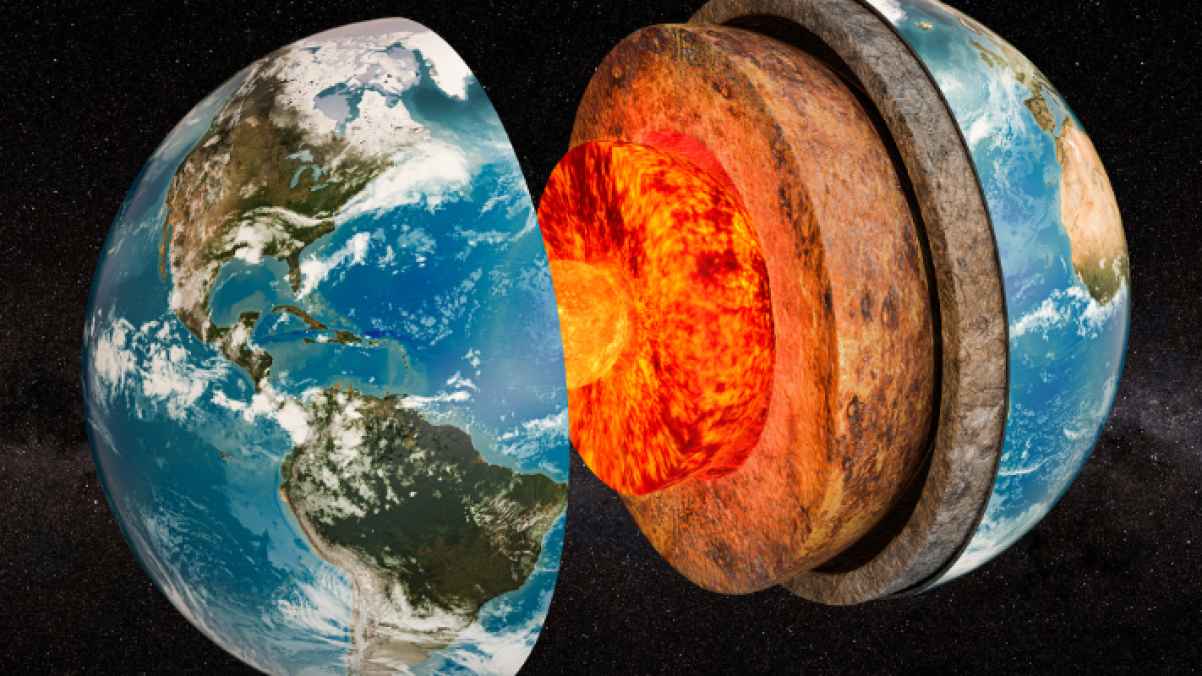
Earth scientists have uncovered new evidence suggesting the possible existence of an unknown layer within the deep inner core of the planet, a finding that could reshape conventional scientific models of Earth’s internal structure.
Studies indicate that Earth’s center may not be a uniform mass as previously thought, but instead contains a distinct region within the solid inner core. Some researchers refer to this area as the “deepest inner core,” located at a depth of roughly 650 kilometers from Earth’s center.
These findings are based on the analysis of seismic waves that travel through Earth’s interior at different speeds depending on the materials they pass through. Scientists observed a shift in wave behavior within this region, suggesting a change in the arrangement of iron crystals there.
According to researchers, this difference could reflect major events in Earth’s early history, such as multiple cooling phases or deep structural transformations, although the exact nature of these events remains uncertain.
Further studies using alternative seismic techniques have supported the same conclusions, detecting signals passing through Earth’s core that show similar variations in wave speeds within the identified region.
Researchers believe these findings may help resolve discrepancies between previous theoretical models and seismic measurements. However, they emphasize that available data remains limited due to uneven global seismic coverage in some regions.
Scientists hope that future research will provide a clearer understanding of Earth’s deep interior and may even lead to a revision of current theories about how the planet formed.