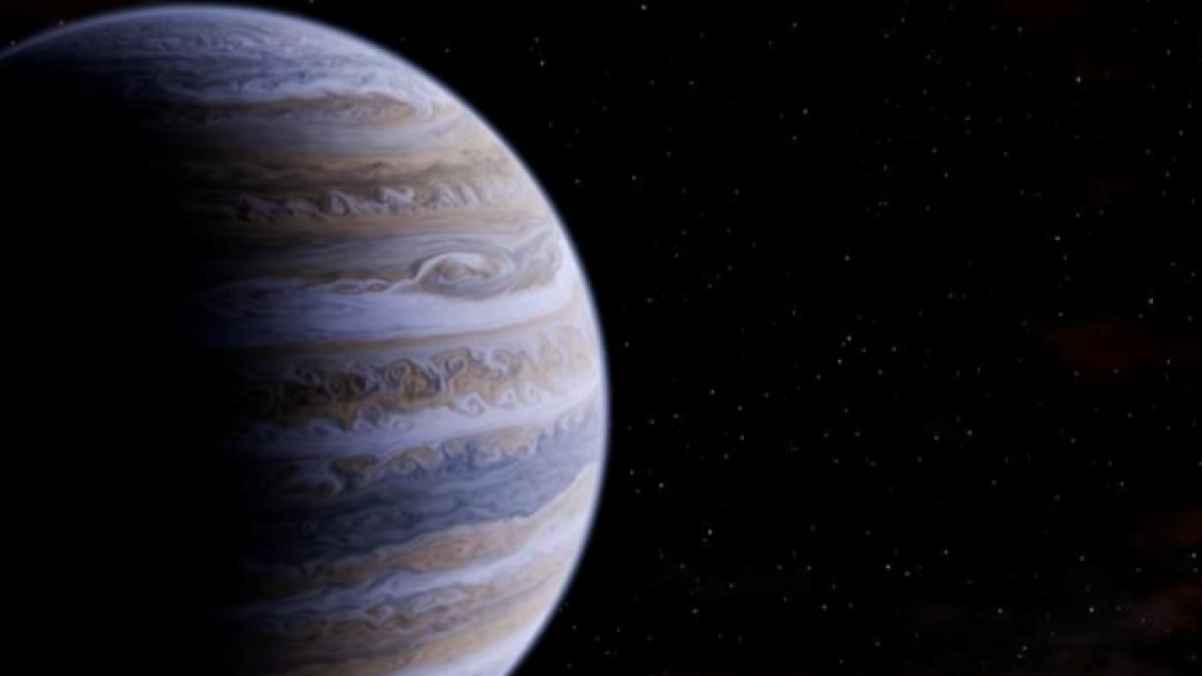
- Unusual gas giant detected with rare chemical properties
- New data reveals surprising features in its atmosphere
Astronomers have identified a Jupiter-like exoplanet outside our solar system, located several light-years away, that appears to have an unexpectedly complex atmospheric composition.
The object, known as Epsilon Indi Ab, was observed using the James Webb Space Telescope. Scientists believe its atmosphere contains ammonia along with high-altitude water clouds, a combination that challenges existing models of cold giant exoplanets.
Researchers say the latest findings reveal unexpected details in the planet’s atmospheric structure, highlighting chemical behavior that does not fully match current theoretical predictions.
The planet has a mass about 7.6 times that of Jupiter, while maintaining a similar size. It orbits its host star at a relatively wide distance, resulting in extremely low temperatures ranging between -70°C and +20°C.
Scientists also note that the detection of water clouds came as a surprise, as such formations are difficult to reproduce in standard atmospheric models, suggesting that these distant worlds may be more complex than previously thought.
NASA’s upcoming Nancy Grace Roman Space Telescope, expected to launch later this decade, is anticipated to further improve the ability to observe and analyze such distant planetary atmospheres in greater detail.